By: RIZA.MD
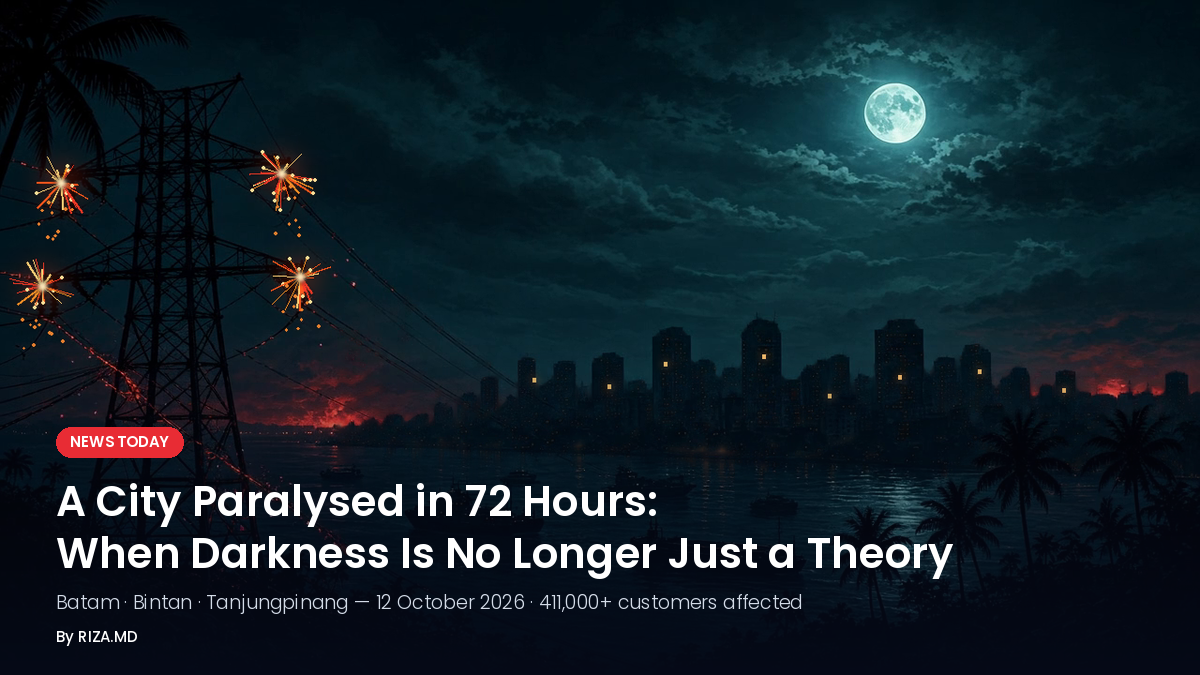
On Monday morning, 12 October 2026, at 06:37 WIB, the power supply in Batam, Bintan, and Tanjungpinang failed simultaneously. More than 411,000 customers were affected. Mobile signal and internet connectivity were also lost, clean water supplies were disrupted, and students were unable to attend online classes. One mother lost 15 litres of expressed breast milk — four months’ worth — when the power was out for 15 hours. In parts of Bintan, the blackout lasted roughly 52 hours. The price of instant noodles rose from Rp3,500 to Rp5,000, and fishermen stopped going out to sea because there was no ice available. PLN Batam cited an initial indication that wild animals had entered a substation, though the exact cause remains under investigation.
Batam was not an isolated incident. On 22 May 2026, a transmission fault caused by severe weather triggered a power swing that led to a cascading shutdown of power plants across Sumatra. On 2 May 2025, Bali was plunged into darkness for nearly 12 hours after the Java–Bali submarine cable was disrupted, with PLN confirming it was not a cyberattack. In Europe, Spain and Portugal were brought to a complete standstill on 28 April 2025 — the worst incident on the European electricity grid in over 20 years. The cause was a chain of voltage control failures, and recovery took between 12 and 16 hours.
So why “72 hours”? The figure is not arbitrary. The European Union’s Preparedness Union Strategy (March 2025) encourages every citizen to be capable of surviving independently for at least 72 hours during a crisis. Indonesia’s National Disaster Management Agency (BNPB) similarly recommends a Disaster Preparedness Kit covering three days’ worth of needs: drinking water, non-perishable food, medicine, a torch, a radio or power bank, cash, and essential documents. Storing water, keeping cash at home, and agreeing on a family meeting point that doesn’t rely on mobile phones are forms of preparedness endorsed by the authorities — not paranoia.
Beyond the technical facts, more far-reaching interpretations have emerged. Dharma Pongrekun warned of a possible “cyber pandemic” that, in his view, could knock out electricity, ATMs, and water pumps for up to seven days. However, the viral video clip claiming “power and ATMs down for seven days” was declared misleading by Cekfakta/Mafindo and Tempo. Sheikh Imran Hosein interprets dependence on digital systems as part of the order of the Dajjal and of Gog and Magog (Ya’juj and Ma’juj). Narratives around a “Great Reset” and “blackout trial runs” have also circulated widely. All of these remain the views of their respective proponents rather than investigative findings, since every major blackout mentioned above has been given a technical explanation by its operator.
Is this string of blackouts mere coincidence? What has been proven is that our power grid is fragile and that transparency around these investigations is lacking. This is where Surah Ar-Ra’d, verse 11, becomes relevant: “Indeed, Allah will not change the condition of a people until they change what is in themselves.” Prepare yourself physically, financially, and spiritually — calmly, without panic, and without falling for hoaxes. Keep an umbrella ready before the rain falls; keep a candle ready before the dark sets in.
📌 Sources:
- BBC News Indonesia: Consumers affected by the Batam–Bintan blackout
- Detik: Batam blackout — PLN suspects wild animal entered substation
- Kompas: Power swing triggers Sumatra blackout
- Kompas: Bali blackout — PLN confirms it was not a cyberattack
- ENTSO-E: Final report on the Spain–Portugal blackout
- European Commission: EU Preparedness Union Strategy
- BNPB: Disaster Preparedness Kit Handbook
- Cekfakta: Claim of power and ATMs down for seven days
- Tempo Fact Check: National blackout claim
- Imran N. Hosein: An Islamic View of Gog and Magog
- NU Online: Surah Ar-Ra’d, verse 11