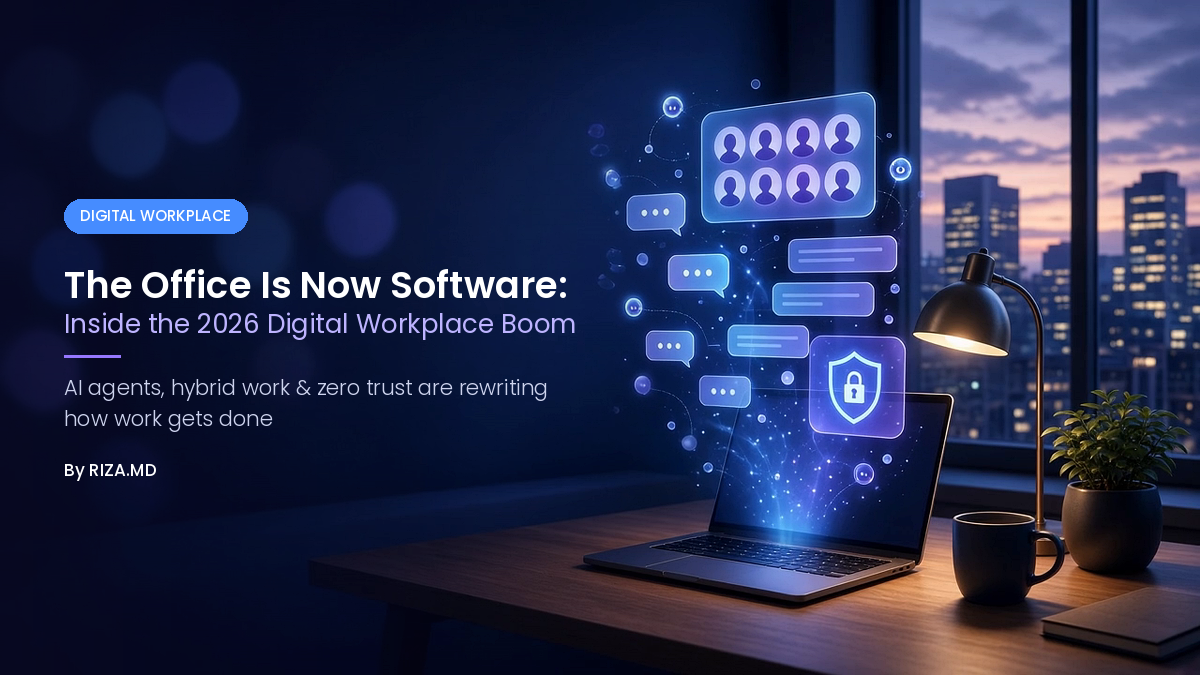
AI agents, hybrid schedules and zero trust security are rewriting how work gets done. Here's what the data says and where companies should start.
By RIZA.MD
The office used to be a building. In 2026 it's a login. Chat, documents, meetings, security and now AI agents all live in one connected layer that follows employees from home to headquarters to phone. Research firms put this market somewhere between roughly $72 billion and $100 billion in 2026, and every major forecast expects it to keep growing at double-digit rates.
What Is a Digital Workplace Solution?
A digital workplace solution is the set of tools that lets people do their jobs from anywhere: collaboration suites, cloud desktops, endpoint management, employee experience (DEX) platforms and, more and more, AI assistants and agents built into all of them. Gartner's 2026 Planning Guide for the Digital Workplace describes the change plainly: organisations are moving from basic generative AI tools to "targeted AI agents grounded in proprietary data."
Why Now: The Numbers Behind the Shift
Hybrid work has settled in. As of May 2026, Gallup finds that 52% of US employees with remote-capable jobs work hybrid, 26% are fully remote and only 22% are fully on-site.
AI is being adopted fast. Microsoft reported more than 30 million paid Microsoft 365 Copilot seats in July 2026, and says active agents in its ecosystem grew 15x year over year. Gartner predicts that 40% of enterprise apps will include task-specific AI agents by the end of 2026, up from less than 5% in 2025.
The money is following. MarketsandMarkets projects the market will grow from $67.57 billion in 2025 to $161.82 billion by 2030. Fortune Business Insights forecasts $74.55 billion in 2026, rising to $388.68 billion by 2034.
Indonesia stands out. In Microsoft's 2026 Work Trend Index, 33% of Indonesian workers qualify as "Frontier Professionals" (advanced AI users), more than double the global average of 16%. And 72% of Indonesian AI users say they now produce work they couldn't a year ago, against 58% globally.
Key Solutions and Tools
- AI copilots and agents. Microsoft 365 Copilot now offers multi-step agents. Google has included Gemini in Workspace Business and Enterprise plans since January 2025, and Slack and Salesforce are building agents into the apps people already use.
- Employee experience (DEX) platforms. Gartner says IT teams are using growing interest in DEX as a reason to modernise and automate endpoint management.
- Cloud desktops and endpoint management. The end of Windows 10 support in 2025 pushed many firms into device refreshes and cloud PC migrations.
- Zero trust security. Every user, device and agent is verified on every request, which matters when the "perimeter" is a café Wi-Fi network.
The Challenges: Security, Burnout and the Digital Divide
Security is the first concern. Verizon's 2026 Data Breach Investigations Report found a human element in 62% of breaches and third parties in 48%. The share of employees frequently using AI tools on work devices tripled in a year, from 15% to 45%, and Verizon flags unapproved "shadow AI" as a growing data-leak risk. Only 13% of organisations think they have the right AI agent governance in place, according to Gartner.
Pressure and burnout are real. In Microsoft's research, 65% of AI users fear falling behind if they don't adapt quickly, rising to 85% in Indonesia. In PwC's Indonesia survey, 41% of workers reported fatigue.
The digital divide is widening. Globally, PwC found that only 51% of non-managers feel they have adequate learning resources, compared with 72% of senior executives. Gallup puts global employee engagement at just 20%.
What's Next and How to Start
Microsoft's 2026 Work Trend Index makes a pointed finding: organisational factors such as culture, manager support and talent practices account for more than twice the AI impact of individual factors (67% vs. 32%). Buying tools isn't enough.
- Audit the employee journey. Find the friction points before choosing tools.
- Govern first. Build an AI agent inventory, assign identities and permissions, and set data access rules.
- Adopt zero trust. Apply it to people, devices and AI agents alike.
- Redesign workflows rather than adding chatbots. Decide what stays human-led and what AI can run.
- Reward experimentation. Only 13% of workers globally say they're rewarded for reinventing work with AI even when results aren't met. In Indonesia it's 41%.
Conclusion
The digital workplace is no longer an IT project. It's how a company works. The winners won't be the firms with the most licences, but the ones that pair smart tools with clear governance, strong security and a culture that lets people learn. For Indonesia, with its fast-adopting workforce, the opportunity is unusually large.
Sources
- Gartner: 2026 Planning Guide for the Digital Workplace (PDF)
- Gartner: 40% of enterprise apps will feature AI agents by 2026
- Gartner: Six steps to manage AI agent sprawl
- Gallup: Hybrid Work Indicator
- Gallup: State of the Global Workplace 2026
- Microsoft WorkLab: 2026 Work Trend Index
- Microsoft Source Asia: 33% of Indonesian workers at the forefront of AI
- Microsoft: FY26 Q4 results
- MarketsandMarkets: Digital Workplace Market
- Fortune Business Insights: Digital Workplace Market
- Grand View Research: Digital Workplace Market
- Google Workspace Help: Gemini included in Workspace
- Verizon: 2026 DBIR news release
- PwC Indonesia: Hopes and Fears 2025