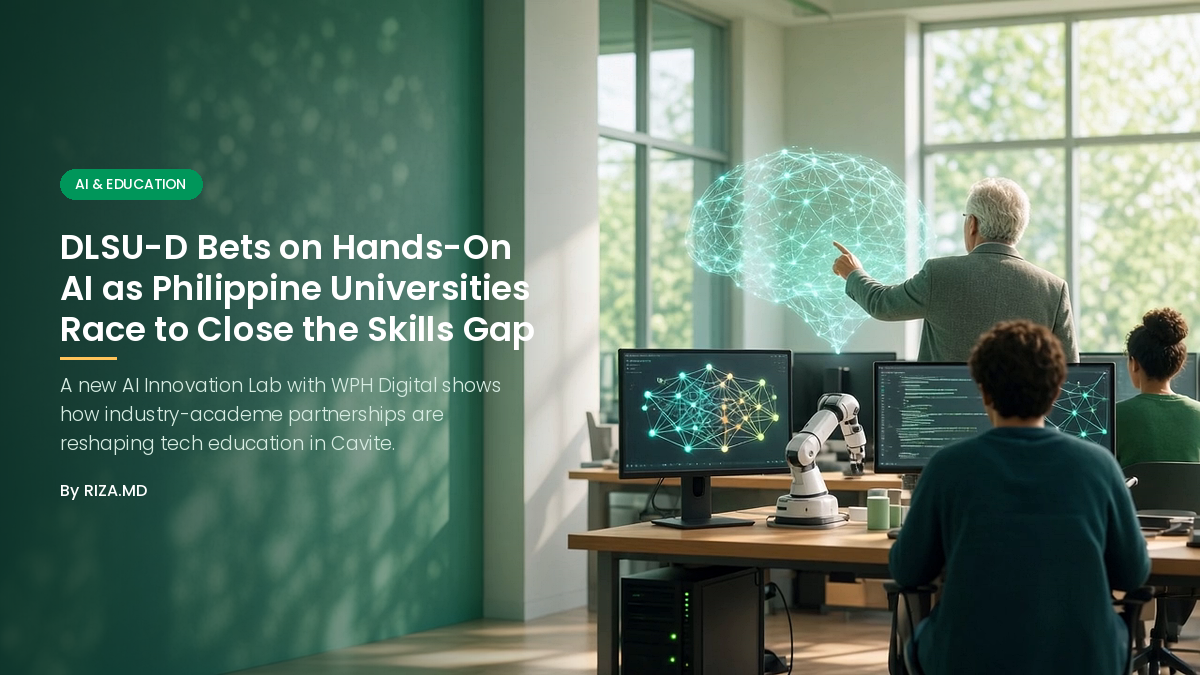
A new AI Innovation Lab with WPH Digital shows how industry-academe partnerships are reshaping tech education in Cavite.
By RIZA.MD
De La Salle University–Dasmariñas (DLSU-D) is turning artificial intelligence from a classroom subject into a workshop. On 4 June 2026 the Cavite university signed an agreement with technology firm WPH Digital to set up the WPH–DLSU-D AI Innovation Lab. It is a proof-of-concept space where students, faculty, industry partners and government agencies can build, test and validate AI solutions using real equipment and real use cases.
What the Partnership Covers
According to DLSU-D, the agreement covers research, faculty development and a jointly organised Annual Tech Summit, with the lab as its centrepiece. Faculty and students of the College of Information and Computer Studies (CICS) will get more training in cloud computing, AI and DevOps. WPH says the deal formalises a relationship that began in 2023. The CICS already offers a BS in Computer Science with a specialisation in Intelligent Systems.
Part of a Wider AI Push at DLSU-D
In April 2026, DLSU-D's technical team completed NVIDIA AI training, which the university called the start of its move toward an "AI-empowered university system." That same month it hosted a research conference on the ethical use of AI for around 1,000 senior high school students. On 9 October 2026 it signed a separate agreement with ITWorks on lifelong learning and industry engagement.
Why Industry-Academe Links Matter Now
The DTI's National AI Strategy Roadmap 2.0 (NAISR 2.0) lists "strengthen industry-academe partnerships in AI R&D" among its 30 strategic actions, and CHED Memorandum Order No. 104, s. 2017 requires universities to build industry links for internships. Globally, the World Economic Forum's Future of Jobs Report 2025 projects 170 million new jobs and 92 million displaced by 2030. It expects nearly 40% of job skills to change, and 63% of employers name the skills gap as their main barrier.
The Media Angle: Why AI Literacy Matters for Journalism
The Reuters Institute's Digital News Report 2026 finds that weekly use of AI chatbots for news rose from 7% to 10% globally, while only 20% of people trust chatbot answers on news. It also names the Philippines among the countries with the biggest drops in trust in news this year. For future journalists, AI literacy covers verification and ethics as well as tools.
What to Watch
The open questions are whether the lab produces working prototypes, research and internship pipelines, and whether other CALABARZON universities follow. The model of industry supplying equipment and use cases while universities supply talent matches what NAISR 2.0 calls for.
Sources
- DLSU-D: DLSU-D Partners with WPH Digital to Advance AI and Cloud Innovation
- WPH Digital: AI Innovation Lab announcement
- DLSU-D: BS Computer Science programme
- DLSU-D: NVIDIA AI training
- DLSU-D: Research conference on ethical AI
- DLSU-D: ITWorks agreement
- DTI: NAISR 2.0 launch
- NAISR 2.0: Thirty Strategic Actions
- CHED: CMO No. 104, s. 2017
- WEF: Future of Jobs Report 2025
- Reuters Institute: Digital News Report 2026