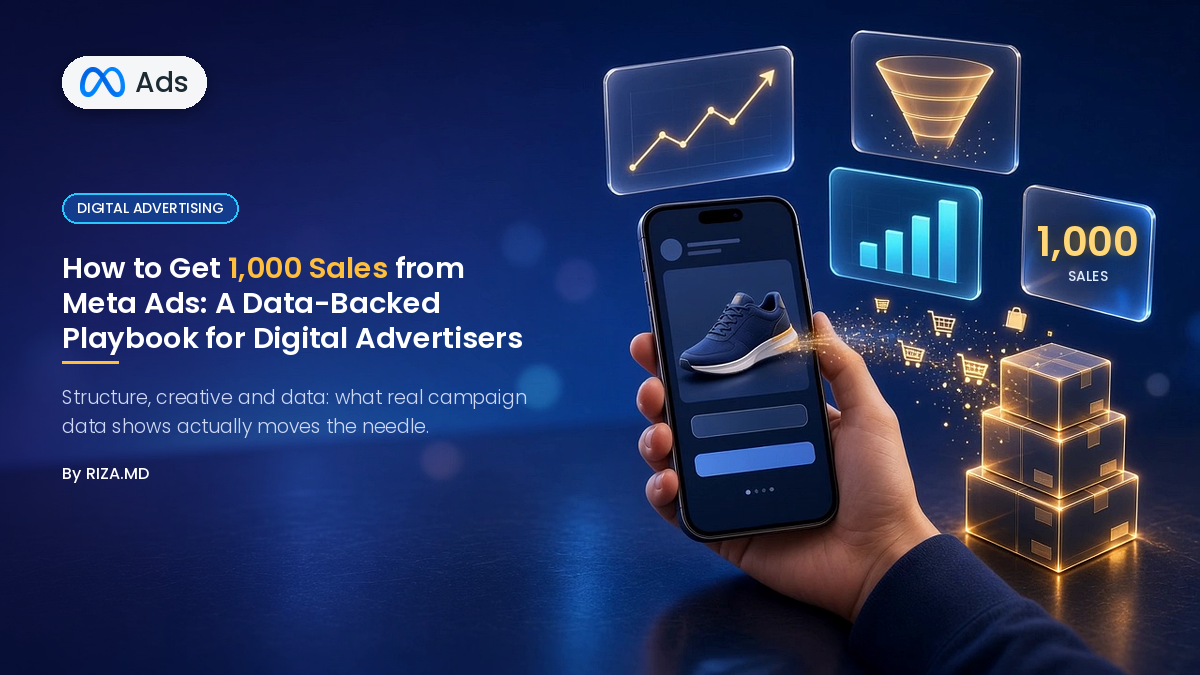
Meta’s advertising engine is bigger than ever. The platform is projected to post roughly US$243 billion in net worldwide ad revenue in 2026, overtaking Google for the first time, with growth accelerating to around 24% year-on-year. For advertisers, that scale comes with both opportunity and noise — more AI automation, but also more competition for the same attention. Reaching a concrete target like 1,000 sales is achievable, but it depends on getting four things right: campaign structure, creative, data feeding, and the maths behind your budget.
1. Let Advantage+ Do the Heavy Lifting — But Feed It Properly
Meta’s Advantage+ Shopping Campaigns (ASC) use machine learning to handle targeting, budget allocation, and placement automatically. The results, when implemented well, are substantial. Spanish skincare brand TAF increased its Advantage+ budget and recorded a 15% rise in conversions alongside a 16.2x return on ad spend for the Add-to-Cart event. Meta’s own reporting from a broader advertiser sample found that advertisers using Advantage+ shopping campaigns saw over 20% more conversions quarter-on-quarter and a 32% increase in return on ad spend — results strong enough that small sellers like cookie-dough brand Doughp shifted their entire budget toward this campaign type. adsmuraisocialmediatoday
The catch: Advantage+ only performs as well as the data you give it. Analysis from CustomerLabs found that feeding first-party customer data into ASC produced a conversion rate four times higher for warm audiences than for completely new prospects, with Meta itself reporting 12% lower cost-per-purchase versus standard campaigns. In practice, this means connecting your pixel, Conversions API, and customer list before scaling spend — not after. customerlabs
2. Creative Is the Real Lever, Not the Budget
It’s tempting to assume more budget equals more sales, but the data says otherwise. A 2025 industry report cited by creative platform Billo found that 70–80% of Meta ad performance comes from the strength of the creative itself, not targeting or budget. This lines up with Meta’s own “Performance 5” guidance, which recommends running broader targeting with fewer ad sets so the delivery system can learn faster, alongside using Meta’s AI creative tools and sending conversion data through the Conversions API. billobeehiiv
Practically, this means:
- Test 3–5 creative variations per ad set, not one
- Prioritise UGC-style or lifestyle video over static product shots
- Refresh creative every 1–2 weeks to avoid fatigue, which hits smaller audiences fastest
3. Use Collaborative Ads (CPAS) if You’re a Reseller or Marketplace Partner
For brands selling through retail partners or marketplaces, Collaborative Ads (CPAS) paired with ASC structures have shown strong lower-funnel gains. Pet-food brand Hill’s Pet Nutrition tested ASC against its standard catalogue strategy and recorded a 162% return-on-ad-spend improvement along with a lower cost-per-purchase compared to business-as-usual campaigns. A separate QSR case study pairing ASC with the Conversions API saw a 53% overall increase in conversions and a 119% jump in location-based conversions within a single month. adparlorgoodwaygroup
4. Reverse-Engineer the Maths
Before setting a budget, work backwards from your 1,000-sale target:
| Variable | Example |
|---|---|
| Target sales | 1,000 |
| Average order value | $40 |
| Target conversion rate (cold traffic) | 1.5–2% |
| Required link clicks | ~55,000–65,000 |
| Estimated cost-per-purchase (mid-range, non-US) | $8–$15 |
| Estimated budget needed | $8,000–$15,000 |
These are illustrative benchmarks, not guarantees — CPP varies heavily by vertical, country, and creative quality, so run a small test budget first to establish your own numbers before committing the full spend.
5. Don’t Skip the Post-Click Funnel
Even flawless ad delivery fails if the landing page leaks conversions. Agencies scaling e-commerce brands in 2026 emphasise that landing pages and product pages need to be treated as part of the ad strategy itself, not an afterthought — slow load times, unclear CTAs, and weak retention systems are what quietly cap campaigns well short of their sales target. brandedagency
The Bottom Line
1,000 sales is a budget-and-structure problem, not a magic-formula one. Feed Advantage+ clean first-party data, invest more in creative variation than in blind budget increases, use Collaborative Ads if you’re a retail partner, and calculate your required spend backwards from your average order value and realistic conversion rate before you launch.
📌 Sources:
- Advanced Television: Forecast — Meta ad revenues to hit $240bn in 2026
- Technology Magazine / Emarketer: How Meta Usurped Google in Digital Ad Revenue Stakes
- Adsmurai: Increasing TAF’s Online Sales with Advantage+ in Meta (Case Study)
- CustomerLabs: Using First-Party Data to Increase Conversions in Advantage+ Shopping Campaigns
- GoodwayGroup: Boosting Conversions With Meta’s Ad Tools (GRADIANT/QSR Case Study)
- AdParlor: Hill’s Pet Nutrition Achieves a 162% ROAS Breakthrough
- Social Media Today: Meta Highlights Effectiveness of AI Targeting Tools
- The Keyword (Beehiiv): Performance 5 — Official Best Practices for Meta Ads
- Billo: Meta Ads Best Practices — What Actually Works in 2026
- Branded Agency: Ecommerce Meta Ads in 2026 — The Strategy Agencies Use to Scale Ecommerce Brands.
Note: the “1000 sales” math table is illustrative, built from public benchmark ranges rather than one specific audited source — you’ll want to plug in your own historical CPP/AOV once you have campaign data running.